|
NATURAL HISTORY
 For the person interested in natural history, whether it is on
land or sea, Gibraltar is incredibly rich and full of surprises
at any time of the year with a wide array of plant life, many of
which are native to the area, the Rock Apes, dolphins in the Bay
of Gibraltar, and other marine mammals which include the Pilot
Whales of the Strait, Killer Whales and even larger species such
as Sperm Whales. Gibraltar also has its own unique bird: the
Barbary Partridge and not to be missed is the spectacular
migration of birds when you can see several thousand of up to
fifteen different species in a single day including birds of
prey, storks, vultures, songbirds and seabirds.
For the person interested in natural history, whether it is on
land or sea, Gibraltar is incredibly rich and full of surprises
at any time of the year with a wide array of plant life, many of
which are native to the area, the Rock Apes, dolphins in the Bay
of Gibraltar, and other marine mammals which include the Pilot
Whales of the Strait, Killer Whales and even larger species such
as Sperm Whales. Gibraltar also has its own unique bird: the
Barbary Partridge and not to be missed is the spectacular
migration of birds when you can see several thousand of up to
fifteen different species in a single day including birds of
prey, storks, vultures, songbirds and seabirds.
In spring, the time when many birds breed, and others arrive from
the south, many insects, including beautiful butterflies, emerge,
making Gibraltar a truly beautiful paradise for wildlife.
Our climate can be summarised as having a summer drought and high
temperatures with cooler weather arriving with the rains any time
between October and Christmas.
PLACES OF INTEREST
We are aware of the limited time on your visit. There are so many
places to visit on the Rock that a short visit will only leave
you wanting to see more. Taking 'The Official Rock Tour' by taxi
or by coach is the best way to visit some of Gibraltar's most
interesting sites. The tour lasts approximately 90 minutes so at
each stop you will have plenty of time to look around.
Simply ask one of our official taxi or coach guides to take you
and your party on 'The Rock Tour' - or you can arrange with him
or her an individual tour of your choice. Alternatively you can
visit the Upper Rock Nature Reserve on the Gable Car which you
can take from Alameda Grand Parade. Here is a tempting selection
of our more popular venues:
ALAMEDA BOTANICAL GARDENS
The Gibraltar Botanical Gardens combine the aesthetic beauty of
the site with living exhibits of botanical interest and
conservation value, centred around "The Dell", a peaceful area
with definite Italian influence in which is displayed the
coat-of-arms of Gibraltar and which holds a series of fountains,
ponds, and waterfalls.
THE CASINO
The Gala Casino at Ocean Village is a glamorous location where you
can enjoy a night to the fullest. With traditional casino games, a Poker
zone, Gala Bingo, and a Sports Lounge. You can enjoy a range of bars and a
meal in the Chargrill restaurant.
CITY GATES AND FORTIFICATIONS
The Walls of Gibraltar run around the entire inner city and were
first built by the Moors. Successive battles and sieges resulted
in the strengthening of the walls by the Spanish and then the
British. Walking along the walls you can begin to glimpse the
historic events which shaped the City of Gibraltar. Over recent years
the Government has been engaged in a beautification process which has
made more parts of the city walls visible.
Some of the more well known sites are:
Jumper's Bastion
King's Bastion
Landport Gate
Line Wall
Prince Edward's Gate
Ragged Staff, and
Southport Gates
CATALAN BAY
This little village nestling on the eastern side of the Rock was
first used by the Genoese who followed the British Fleet,
repairing the ships as required. The descendants of these
shipwrights still live in this sleepy village, where there are
still some who go fishing in the traditional boats. Its beach is
tiny but excellent and there are a number of small pubs and
restaurants in the village.
THE CONVENT
The official residence of the Governor of Gibraltar since 1728,
it was a convent of Franciscan Friars who took abode there in
1531. It is said that the Convent is haunted by the Grey Lady - a
Franciscan Nun who was caught trying to elope with her
sweetheart.
The adjacent King's Chapel formed part of this convent. It has
been the garrison church since the British took Gibraltar and
inside, beneath the colours of several British regiments, lie the
remains of two British Governors.
The changing of the guard outside the Convent is one of the military
ceremonies which can be seen. It takes place several times daily on
week-days and special ceremonial events are held at regular intervals
throughout the year. Further information can be obtained from the
Gibraltar Information Centre. The guard is normally provided by the
Gibraltar Regiment, part of the British Army, however sometimes you may
see other visiting soldiers on duty.
CRADLE OF HISTORY
This Welcome Monument in the shape of the rock, depicts
Gibraltar's important location throughout history. It shows the
first skull of Neanderthal Man, which was found in Gibraltar,
although not identified as such until later, as well as one of
the pillars of Hercules, and other images which represent the
many civilisations that form part of Gibraltar's rich and varied
history.
THE FRONTIER
Closed by the Spanish Government in 1969, the Frontier reopened
without restrictions on the 5th February, 1985, and is now
crossed by over six million visitors each year.
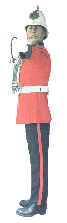 A model of the Port Sergeant holding the Keys of Gibraltar can be
seen by the Information Centre at the Old Guard Room. This
represents the tradition began by General Sir George Elliott who
was Governor of Gibraltar during the Great Siege when he carried
the keys of the garrison on him at all times and was even said to
have slept with them under his pillow!
Since then successive Governors have kept up the tradition by
carrying the keys on all official functions. The only time when
the keys were not in the possession of the governor was when they
were handed over to the Port Sergeant for the daily ceremonial
opening and closing of the gates of Gibraltar - a daily task
carried out by the Garrison until the beginning of the century.
A model of the Port Sergeant holding the Keys of Gibraltar can be
seen by the Information Centre at the Old Guard Room. This
represents the tradition began by General Sir George Elliott who
was Governor of Gibraltar during the Great Siege when he carried
the keys of the garrison on him at all times and was even said to
have slept with them under his pillow!
Since then successive Governors have kept up the tradition by
carrying the keys on all official functions. The only time when
the keys were not in the possession of the governor was when they
were handed over to the Port Sergeant for the daily ceremonial
opening and closing of the gates of Gibraltar - a daily task
carried out by the Garrison until the beginning of the century.
The full ceremony is now re-enacted twice a
year and information on when held can be obtained from the
Gibraltar Information Centre in Main Street.
GIBRALTAR FLAG AT THE JOHN MACKINTOSH HALL
A LEGO flag of Gibraltar 4 metres in height and 8 metres in
length can be seen at the John Mackintosh Hall, which is a
cultural centre housing the public library as well as exhibition
rooms and a theatre. At the time of its construction, the LEGO
flag was the largest flag ever made from LEGO bricks with a total
of 393,857 LEGO bricks being used.
THE GLASS FACTORY
Visit to one of the few glass factories in Southern
Europe producing hand-made glass. Using methods which are over
2,000 years old, the glass blowers will create and shape the
glass objects as you watch. A shop at the factory sells these
objects at factory prices.
THE LIGHTHOUSE
The lighthouse at Europa Point is the most southerly of all
Trinity House Lighthouses, and is the only one maintained by them
outside the United Kingdom. Until recently it was manned, however
like all lighthouses it is now remote controlled, although the
lighthouse keepers cottage is preserved.
THE PUBLIC MARKET
Still in use today by many small businesses, the foundation stone
for the new public markets was laid by the governor Sir Charles
Monro on the 20th June, 1928.
THE GIBRALTAR MUSEUM
The Gibraltar Museum is centrally located at in Bomb House Lane
within the City, just one minute walking distance from Main Street.
It has a rich content covering all aspects of Gibraltar's history and
natural history, and is therefore a must for every visitor.
It houses the best-preserved Moorish Bath House in Europe and contains a
rich collection of artefacts, weapons, medals, costumes, coins and
postage stamps, together with a magnificently detailed old model of
the Rock, constructed by officers of the Royal Engineers in 1865.
NELSON'S ANCHORAGE
No visit to Gibraltar is complete without a visit to Nelson's
Anchorage. There are magnificent views across the Strait of
Gibraltar and of Rosia Bay where Nelson's body was brought aboard
H.M.S. Victory after the Battle of Trafalgar, as well as the
unique '100 ton gun' - the Victorian Super Gun which is within
the general area. To the South is Parson's Lodge Battery which
dates back to 1875. It dominates the southern side of Rosia Bay
and was built on the old reinforced Spanish walls which can still
be seen today,
PLACES OF WORSHIP
Gibraltar prides itself with its religious tolerance and boasts
of two cathedrals, four synagogues, a Hindu temple and a mosque
as well as numerous churches and other places of worship of
various denominations. The following are in the town centre:
- Anglican Cathedral of the Holy Trinity
- Catholic Cathedral of Saint Mary the Crowned
- The Great Synagogue
- St Andrew's Presbyterian Church
SHRINE OF OUR LADY OF EUROPE
This former mosque was converted into a Catholic chapel in 1462
after the capture of Gibraltar by the Spanish. Since that time, a
light was kept burning in a tower above the chapel - a forerunner
to our present day lighthouse at Europa Point. Our Lady of Europa
has been venerated through the ages by seafarers, many of whom
presented rich gifts to the Chapel. However, the greatest
"treasure" - the statue of Our Lady which was brought back to
Gibraltar in 1864, can still be seen at the Shrine.
Europe Day (5th May) is now celebrated annually. Outside the
chapel, there is a fragment of pavement once thought to have
dated back to the Moorish occupation, but which is more likely to
have been laid down around the beginning of the 18th century.
There is also an old whipping post which dates back to the time
that the shrine was used as a guardroom by the British.
>
TRAFALGAR CEMETERY
Situated just outside the city walls, by Southport Gates, it was
Gibraltar's Military Cemetery. It was named The Trafalgar
Cemetery in memory of the casualties of the Battle of Trafalgar
who were buried in these grounds. Every year, on Trafalgar Day, a
ceremony is held here to commemorate the great victory.
UPPER ROCK NATURE RESERVE
The flora and fauna of the Upper Rock Nature Reserve are of
conservation interest. Within it are many of the animals and
plants described in the Natural History section of this Fact File
but the highlights are the Barbary Macaques (the famous Rock
Apes), the Barbary Partridges, and flowers such as Gibraltar's
own Chickweed, Thyme and Candytuft.
GENERAL INFORMATION
Admission into the Nature reserve between 9.30 in the morning and
sunset is by entrance ticket. The recommended way of visiting the
reserve is by taking a Rock Tour or, alternatively, via the Cable
Car.
'GIBRALTAR. A CITY UNDER SIEGE' EXHIBITION
The buildings in which this exhibition is housed are probably
among the first constructed by the British in Gibraltar. A major
feature is the graffiti on the walls, the earliest dated 1726.
GREAT SIEGE TUNNELS
The now famous labyrinth of tunnels inside the Rock ,includes the
Great Siege Tunnels, and is arguably the most impressive defence
system devised by humans.
>
MONUMENT AT JEWS' GATE
This monument was commissioned to depict the "Passage of Time"
and Gibraltar's association with the Pillars of Hercules and shows
Hercules supporting the world.
>
THE MOORISH CASTLE
The accessible part of the old castle is the Tower of Homage
which dominates the hill side and landward approach to
Gibraltar. It dates to the year 1333 AD. Seen to the right is one of the three Marinas.
>
ROCK APES
The "apes" are really tail-less monkeys found wild in Morocco and
Algeria, with the ones on the Rock being the only free-ranging
ones in Europe. At the Apes' Den (Queen's Gate) or around the
Great Siege Tunnels you have the opportunity of seeing these fascinating
monkeys at close quarters. Please remember that although they are normally
well behaved, they are wild animals and despite their relative size can be dangerous.
ST. MICHAEL'S CAVE
St Michael's Cave, has attracted visitors since Roman times and
during World War II the cave was prepared as an emergency
hospital, but it was never used. The Cathedral Cave is open to
visitors and is also an unique auditorium for concerts, ballet,
drama and presentations.
>
SHOPPING
Main Street, with its adjoining lanes and byways offers a large
selection of goods, transforming this area of Gibraltar into what
has often been called the shopping centre of the Western
Mediterranean.
The range of gifts is quite enormous whether it be delicate
glassware, priceless porcelain, an unusual piece of pottery,
leatherware, perfumes, spirits, jewellry, silks or cashmere.
Gibraltar has the most cosmopolitan variety of goods at the most
competitive tax reduced prices in Western Europe.
The currency is Sterling, with notes issued by the Government of
Gibraltar. UK notes are accepted as are Euros by most shops and bars
but not by the Post Office. If you require to change any other
currency into pounds, a large number of Banks and Bureaux de Change
are available. Credit and Debit cards are accepted in most places.
Large Euro notes may be refused due to the possibility of fraud.
Gibraltar issued notes are not legal tender in the UK but must be exchanged
at banks there, or at local banks on a 1:1 basis.
Shops normally open between 9.00 a.m. and 7.30 p.m. during
weekdays and half days on Saturdays. Many, but not all, are
closed on Sundays.
| 
 Essentials