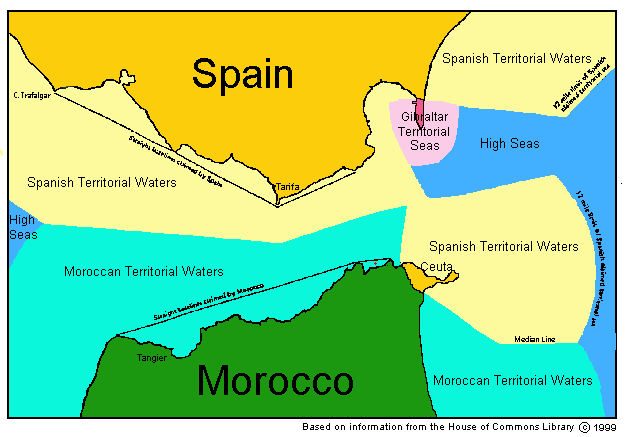
Gibraltar Territorial Waters
|
The legal
Basis Regarding Gibraltar Territorial Waters |
In the 15th & 16th centuries Spain and Portugal claimed dominion over whole
oceans (mares clausae) purporting exercise a legal right to exclude ships
of all other nations.
In the 17th century Britain made similar claims over her surrounding seas. Both claims were intolerable to shipping and fisheries. At the beginning of the Seventeenth Century the first and probably greatest jurist of public international law, Hugo Grotius, propounded in his writings the doctrine of the "mare liberum" or "freedom of the sea" for all vessels. By the first half of the 18th century the concept of the three-mile wide sovereign territorial sea emerged, and this was eventually adopted by most countries as the basis of marine jurisdiction, until the UN Convention on the Law of the Sea 1982, which entered into force in 1995, set a new standard of 12 nautical miles. Most countries, including the members of the European Union, are signatories to the Convention. It applies to Gibraltar. Spain added a comment regarding Gibraltar at the time of its adherence to the Convention which is of no legal effect in modifying the terms of the Convention, It does, however, record the view taken by Spain on this point, a view which no other signatory to the Convention accepts or accedes to. Under the Convention Gibraltar generates its own "Territorial Sea" of 12 nautical miles, or out to median lines where other states’ coastlines are under 24 nautical miles distant from Gibraltar. This is the current position to the North West and South, but not to the East/South East, because, although Spain and Morocco each have claimed the 12 nautical miles of the Convention (although Spain refuses to accept part of Morocco’s calculation of the median line to the West) Gibraltar has not yet extended its legal jurisdiction from 3 to 12 miles, so part of the waters to the East/South East remain international waters, though it is open to Gibraltar to annex these waters to its jurisdiction in accordance with its rights under the U.N. Convention.
|
|
United
Nations Reference
|
UN Convention on the Law of the Sea website |
|
Spanish
Statement [part] | 2. In ratifying the Convention, Spain wishes to make it known that this act cannot be construed as recognition of any rights or status regarding the maritime space of Gibraltar that are not included in article 10 of the Treaty of Utrecht of 13 July 1713 concluded between the Crowns of Spain and Great Britain. Furthermore, Spain does not consider that Resolution III of the Third United Nations Conference on the Law of the Sea is applicable to the colony of Gibraltar, which is subject to a process of decolonization in which only relevant resolutions adopted by the United Nations General Assembly are applicable. |
|
The British
Statement [part] |
With regard to point 2 of the declaration made upon ratification of the Convention by the
Government of Spain, the Government of the United Kingdom has no doubt about the sovereignty
of the United Kingdom over Gibraltar, including its territorial waters. The Government of the
United Kingdom, as the administering authority of Gibraltar, has extended the United Kingdom's
accession to the Convention and ratification of the Agreement to Gibraltar. The Government of
the United Kingdom, therefore, rejects as unfounded point 2 of the Spanish declaration.
|
|
Interpretation
of these Statements |
The matter was discussed at the House of Commons Foreign Affairs Committee in 2008, and later clarified
in a statement by the Government of Gibraltar:
A summary of the correct position is as follows: - (1) The 1958 Convention on the Territorial Seas and Contiguous Zone has been applied to Gibraltar. It provides (Article 1) that the Sovereignty of a State extends beyond its land territory to a belt of sea adjacent to its coast. Spain did not enter any reservation to the above, such as would relieve her of the legal effects of this provision. The Treaty of Utrecht is totally irrelevant to the legal effect of the 1958 Convention. (2) Accordingly, British Sovereignty of Gibraltar's "land territory" entitles it to Sovereignty of "a sea belt adjacent to its coast." Britain has declared 3 miles. (3) The United Nations Law of the Sea Convention of 1982 has been extended to Gibraltar. It provides (Article 3) that every state has the right to establish the breadth of its territorial sea upto a limit not exceeding 12 nautical miles. The 3 miles declared by Britain is thus squarely within the entitlement bestowed by the Convention. Spain has not entered a reservation to the above, and indeed she was precluded from doing so by the terms of the 1982 Convention (Article 309) itself. (4) Spain did make statements and declarations but, Article 310 of the 1982 Convention makes it clear that such statements and declarations cannot exclude or modify the legal effect of the provisions of the Convention in their application to Spain. (5) Accordingly, by virtue of these Conventions the UK has a treaty right to territorial waters in Gibraltar not exceeding 12 miles. The UK has declared 3 miles. Spain’s statements and declarations have no legal effect in altering this position. Her political assertions to the contrary are thus unsustainable in international law, which is what the Chief Minister said to the Foreign Affairs Committee. |